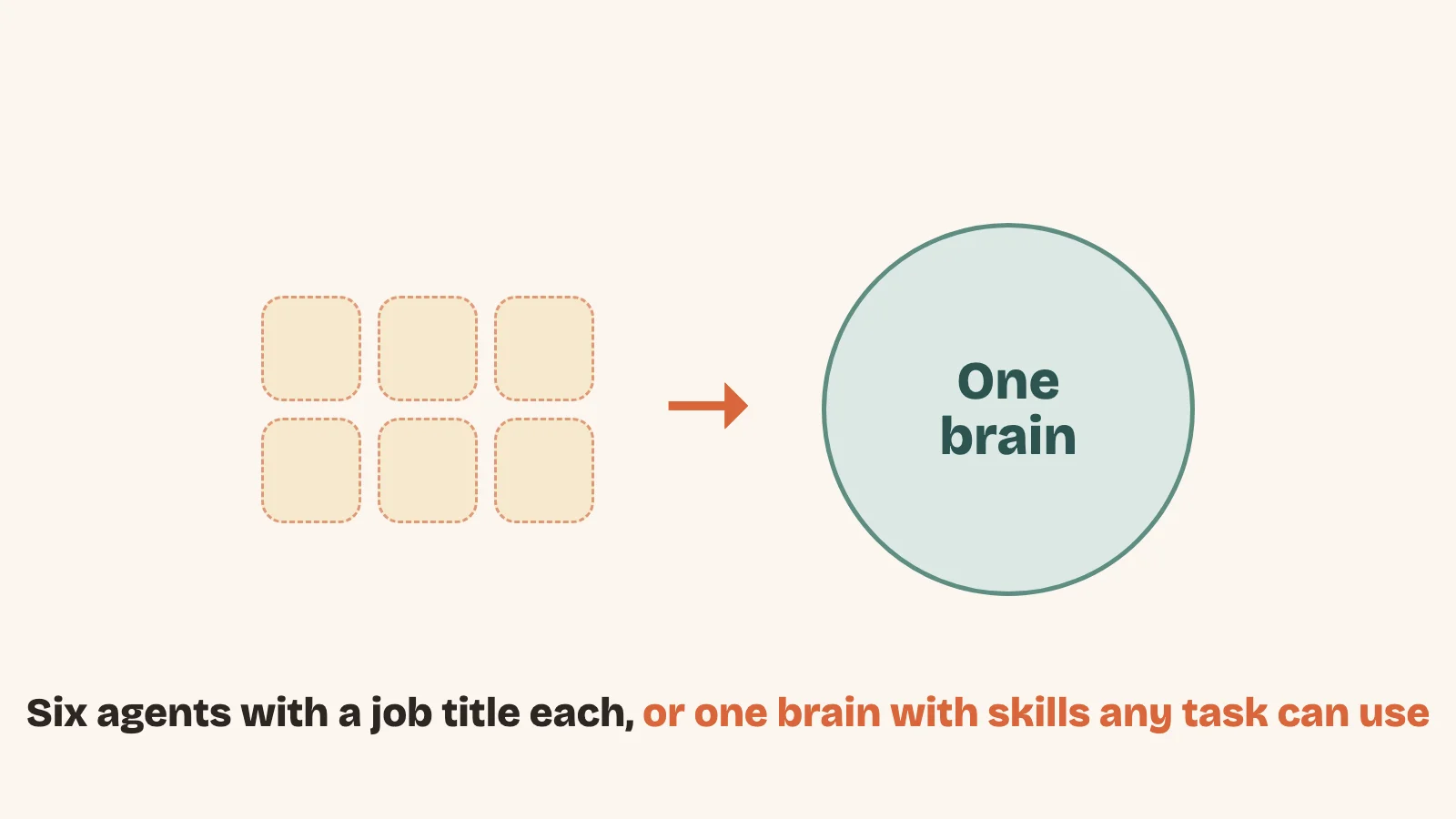
Agents as Employees, or One Brain?
Should you build a team of AI agents, one per role, or one brain with skills any task can use? Where the know-how lives, what the job titles cost you, and how to set up one brain, with the prompts to do it.
ReadThoughts on AI, business automation, and the future of marketing.
Quick thoughts distilled from recent posts.
Should you build a team of AI agents, one per role, or one brain with skills any task can use? Where the know-how lives, what the job titles cost you, and how to set up one brain, with the prompts to do it.
Read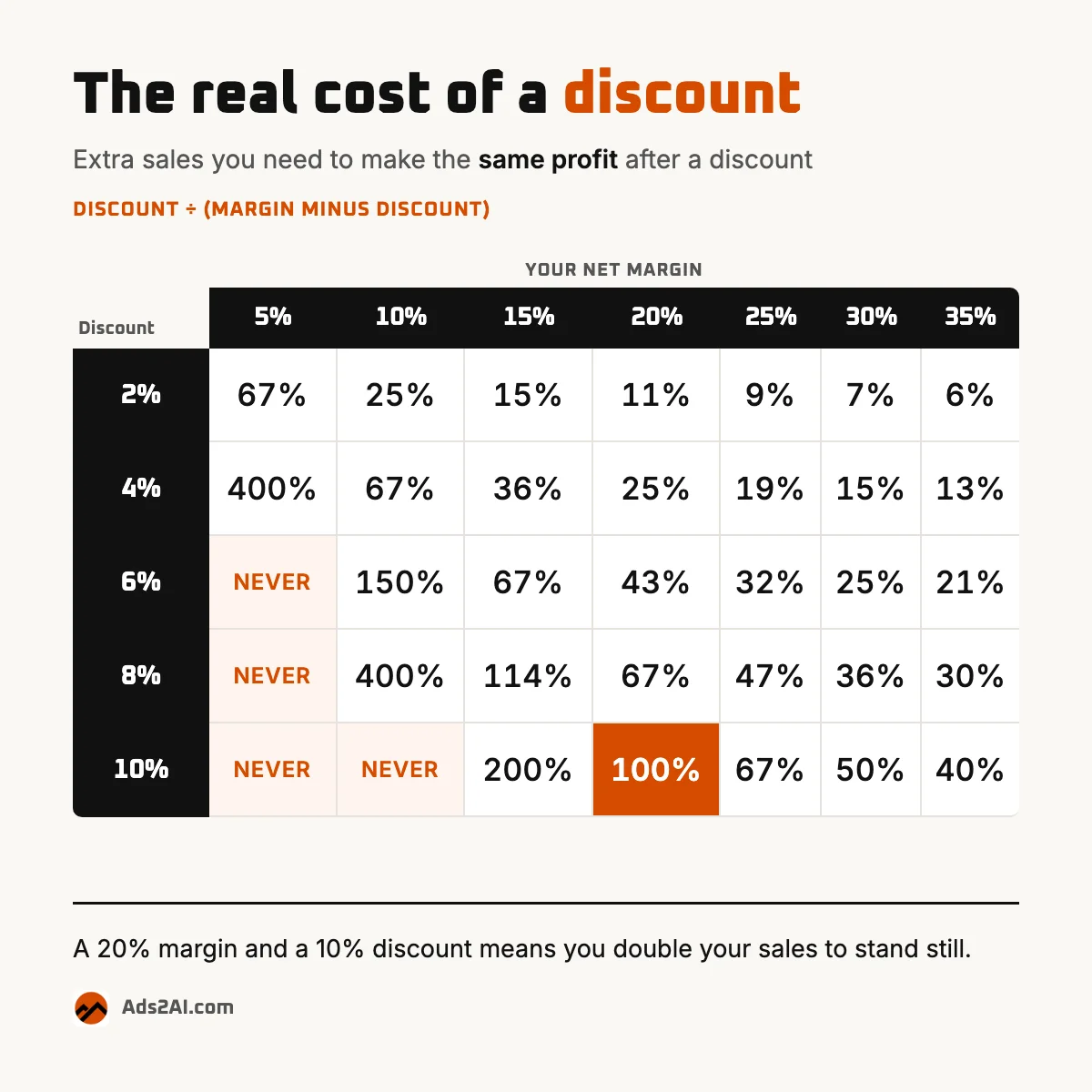
Three tables: the real cost of a discount, the real benefit of a price rise, and how many clients you can lose and keep the same profit. At a 20% margin, a 10% rise covers losing a third of them. Plus when a discount is the right call.
Read
Everything that feels hard to a person turns out to be easy to build, and everything that feels effortless turns out to be brutally hard. Here is why, and what it tells you about what to hand a machine.
Read
Reward is a forecast rather than a feeling, and imagination is a cost saving device. Between them they explain most of what is good and most of what is missing in the AI you use every day.
Read
Today's AI is superb at the newest trick a brain ever learned, and thin on everything underneath it. Once you can see that, you can look at any job and guess how it will go before you hand it over.
Read
Six marks on one line, from basic tasks you check word by word, through context, skills and systems, to work that runs and improves without you. Where you are, what's a little further out, and how to go further without getting burned.
Read
Building is cheap now, so the build isn't the moat. Decision (should it exist), design (how it's built), differentiation (why yours), distribution (how people find it) and discernment, the thread through all of them.
Read
The future isn't a date on the horizon. It already arrived, in the overlap of business, marketing and AI. What I see from where I'm standing.
Read
AI that makes you more of what you already are. An extra human on your team. And time to focus on the extra-human stuff.
Read
The tasks change but the purpose never does. That's been true for a century of advertising.
Read
You speak about 150 words a minute and type about 40, and when you talk you add the backstory AI needs. How I use Wispr Flow to talk through a task and drop the text wherever my cursor is.
Read
Claude Code no longer guesses at your numbers. It writes and runs small scripts to sort, filter and calculate. Ask "which search terms spent over $50 with zero conversions?" and it works out the answer, no coding needed.
Read
Terrible delegation habits? Perfect training for the age of AI.
Read
One question fixes an AI mistake for good: which file should we change so you never do that again? It points to its instructions, a skill or a context document, and each fix adds to your brain's memory. Asking why only gets you a made-up reason.
Read
Treat each AI answer as one spin of a slot machine, not the final word. Change the prompt, context or data and run it again. Examples for a competitor report, email copy and a dashboard.
Read
The hardest thing isn't building anymore. It's stopping.
Read
Code does the same thing every time but can't reason. AI reasons but forgets how you like things done. A skill gives you both. What skills are, how the AI picks the right one for a task, and how to start.
Read
Both ways, step by step, and which to pick: Claude.ai for self-contained skills you want to share, the 8020brain when the skill needs your business context, connected tools and past work.
Read
The data never to share (passwords, API keys, financial and health details, full customer records), when a person must check AI output before it goes out, and the basics of running the policy. Members get a template you fill in with your company name.
Read
A job is a bundle of tasks. Manual bids and keyword sculpting are going. The checks nobody runs (conversion thresholds, broken CRM syncs, tracking) matter more than ever. How to turn what's in your head into skills.
Read
Describe the outcome, not the steps. Share why it matters. Ask for a plan before it starts. Give feedback and run it again. The same management skills work with people and with AI.
Read
Start with a few blocks (your tone of voice, your products, your customers), then connect tools like Gmail. Small systems follow: email replies drafted in Gmail, website content, campaign reports and competitor research.
Read
Both need the same credentials (a GCP project with Google Ads API access, an OAuth client and a refresh token). MCP pours the data into the chat; an API script saves it as CSV files you can analyse, chart and schedule. Use MCP for quick one-line questions and the API for real analysis.
Read
After a 30-minute setup you give plain-English instructions, like adding negatives or flagging junk search terms. Then you describe how you do a task and it becomes a skill. Free videos cover every setup step.
Read
Put your effort into the first 10% (define the outcome and which exceptions you want to hear about) and the last 10% (feedback so it gets better). Hand AI the middle 80% instead of correcting every line.
Read
Think AI is too difficult? If you grew up playing Super Mario, you already have every skill you need. 😆
ReadA series on AI adoption, team transformation, and building for the future.

Eight years ago, I said AI wouldn't take your job. I was wrong. Here's what I've learned watching the shift.
Read
The biggest unlock with AI isn't the technology. It's trust. Here's how the flywheel works.
Read
When everyone uses the same models, the advantage comes from how you use them. Engineer diversity into your process.
Read
Ideas don't appear from nowhere. They're sparked by inputs colliding with problems. Just-in-time vs just-in-case.
Read
Swap dashboard checks for a daily AI briefing: what changed overnight, which accounts need attention, and one line for everything that's fine. Mine took 45 minutes of checking down to 3.
Read
Perfectionism is a productivity killer wearing a quality costume. Ship at 80%.
Read
If you're reading, learning, and experimenting - you're early, not late. Most businesses haven't really started.
Read
Certainty is what clients want most. Scouts run ahead, test the terrain, and return with maps.
Read
A 10-minute task done twice a day costs 86 hours a year, so an hour spent automating it pays back within a week. Which tasks to automate first, my do-it-three-times rule, and a daily search term check cut from 20 minutes to 3.
Read
Creativity and play aren't distractions. They're leverage. Every good presentation is a story.
Read
AI adoption isn't an upgrade. It's an adventure. When you expect failure as learning, everything changes.
Read
AI is a left-brain tool. Relationships, taste, judgment, meaning - these remain stubbornly human.
Read
Accountability isn't about doing more work. It's about doing what matters. AI as mirror and nudge.
Read
Every person carries decades of experience and wisdom. AI can help capture what would otherwise be lost.
Read
Privacy isn't binary. It's a trade-off. Neither fear-mongering nor naivety is useful.
ReadReflections on AI transformation written in December 2024.

The future divides into two paths: those using AI like it's 2022, and those achieving what looks like magic.
Read
Why traditional approaches to business operations are becoming obsolete.
Read
A deep dive into ad spend optimization in the age of AI.
Read
Exploring the transformative potential of AI agents.
Read
The challenges and solutions in scaling business expertise.
Read
How advertising is transforming through AI integration.
Read
Leadership in the age of AI orchestration.
Read
A practical guide to implementing AI agents in your business.
Read
How AI is redefining productivity and focus.
Read
Bringing it all together - the future of business with AI.
Read