A member asked me on a call how to build AI agents that work like employees. She runs three clients, wants five, and is already out of hours.
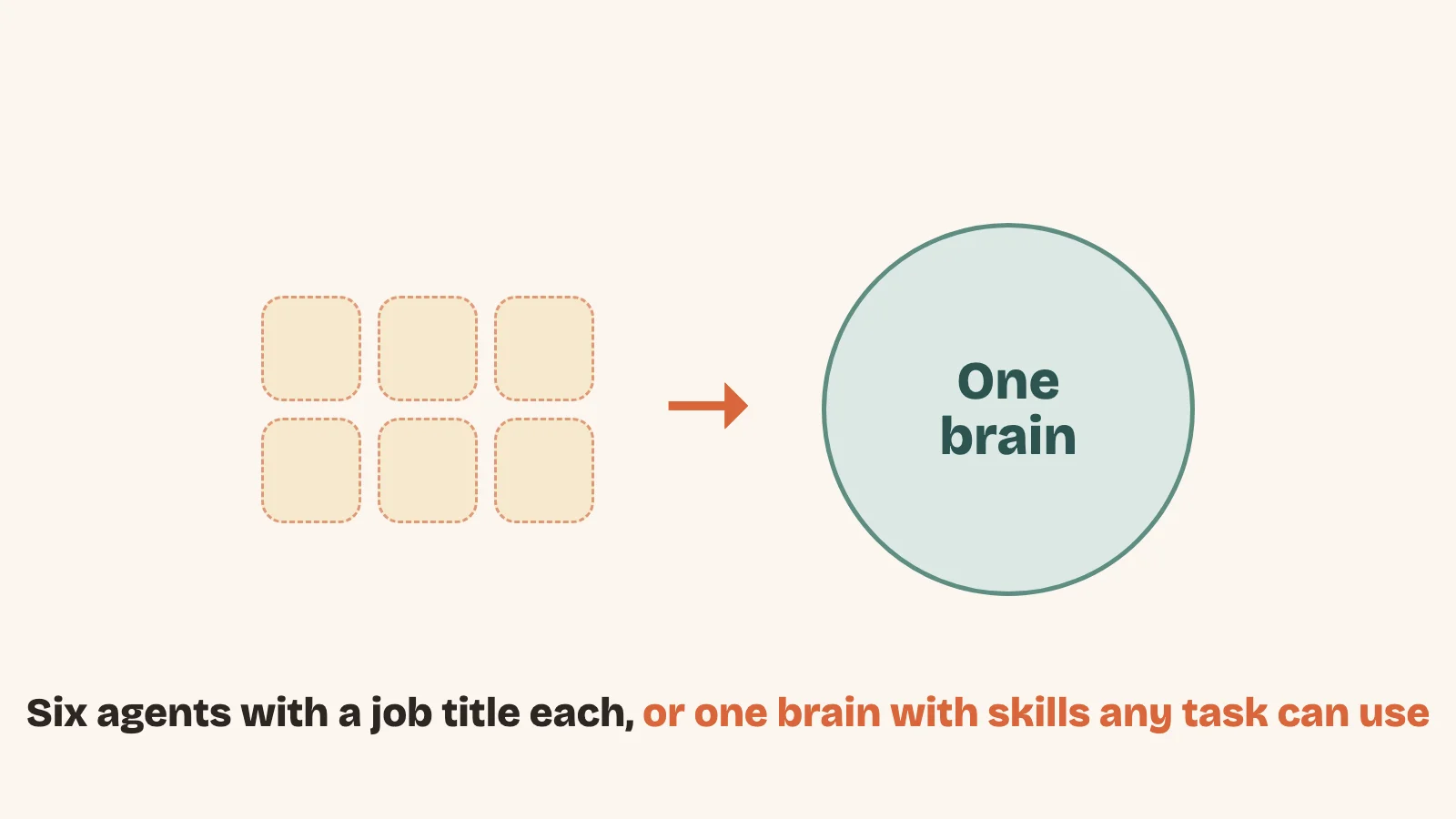
My answer was to skip the team and build one brain. Here are the two pictures side by side.
Two ways to picture AI in your business
Both can know everything about your business. The difference is where the know-how for each task lives.
A team of agents
You
Designerits own how-to
Copywriterits own how-to
Analystits own how-to
Ad writerits own how-to
Landing pagesits own how-to
Reportsits own how-to
Your business, your clients, your products
You send work to a job title. The know-how is locked inside each agent.
One brain
You
The brain
Design a pageWrite ad copyAnalyse an accountBuild a reportReview a landing pageCheck the numbers
skills any task can use
Your business, your clients, your products
You ask for a task. The brain picks the skills it needs.
Both pictures can know everything about your business, your clients and your products. What changes is where the know-how for each task lives. On the left, it's locked inside a job title. On the right, it's a set of skills that any task can use.
I still use agents. To me, an agent is Claude working through a task on its own, using tools, until the task is done. I often have it send out sub-agents, temporary helpers that each do one piece (research, or checking numbers), read the same brain, and are gone once they hand back. What I don't do is give agents permanent job titles, each with its own instructions.
Why agents feel right
Every business you've seen splits work by role, because people specialise.
Why businesses split work by role
People are brilliant at some things and not at others, so a business hires one person per skill.
CopywriterWordsSpreadsheets
AnalystSpreadsheetsDesign
DesignerDesignWords
Your AIWordsSpreadsheetsDesignCodeResearchStrategy
plus everything it knows about your business, your clients and your products
Your AI doesn't have those limits. Put it in one role and it can't use what it knows from the others.
What the job titles cost you
Most real tasks cross roles. A client report needs data, analysis, writing and checking, so with a team of agents it passes through four of them. Click through it both ways.
Follow one task through both
The task: write Client C's monthly report. Both setups read the same notes about Client C. Watch what happens between the steps.
Some setups give every agent the same shared notes, and that's a good move. At that point, you've built one brain with job titles on top.
The upkeep costs you too. A model doesn't change between chats, but the instructions you give it do. Every agent keeps its own copy of how to write and how to check, so a fix in one doesn't reach the others.
Where your fixes go
The AI only gets better when its instructions get better. So how many copies are you keeping?
A team of agents
Copywriter's voice rulesup to dateEmail agent's voice rulesup to dateAd writer's voice rulesup to dateReports agent's voice rulesmissed last week's fixAnalyst's checking rulesup to dateReports agent's checking rulesup to date
Five copies are right. One missed a fix, and the report uses that one.
One brain
One writing skillused by every task that writes
One checking skillused by every task with numbers
Fix it once, and every task that uses it gets better.
What one brain looks like
What's inside the brain
Three things you build up over time. You stay in charge of all of it.
ConnectorsHow it reaches your data: Google Ads, your inbox, your files
SkillsThe best way to do each task you repeat, written down once
ContextWhat it knows: you, your business, each client, how you write
YouYou decide what good looks like, and you check the work
On your computer, the brain is a folder of files: your rules, your skills and your context. For each task it reads a handful of them, and each one for a reason.
What the brain reads for a task, and why
Your brain is a folder of files. Pick a task to see which files it reads, and the reason for each one.
my-brain
CLAUDE.md
.claude/skills
monthly-report
weekly-newsletter
clients
CLAUDE.md
client-c
profile.md
october-report.md
products
this-weeks-offers.md
content
CLAUDE.md
newsletter-oct-24.md
Every file is read for a reason you can see and change. When the brain misses something, add the rule that points at it.
Rules load because you're working in their folder, a skill loads because its description matches what you asked for, and anything else gets read because a rule points at it. When the brain misses something, ask which rule would have sent it there, and add that rule.
In newer brains, each CLAUDE.md points at an AGENTS.md file beside it. It's the same idea, and other AI tools can read it too.
Already built some agents?
You don't have to start again.
Already built some agents? Nothing's wasted
Every part of an agent has a home in the brain.
Its instructionshow it does the work→A skillwritten once, any task can use it
What it knowsabout you, a client, a product→Contextin the folder it belongs to
The tools it usesGoogle Ads, Gmail, Sheets→Connectorsshared by everything
Paste this into your brain
I've set up these AI agents: [paste each agent's name and instructions].

Help me fold them into one brain. For each agent, turn its instructions into a skill, move what it knows into the right context file (about me, my business, or a client's profile), and list any data it connects to.

Show me the plan before you change anything.
Think in tasks, not agents
One brain is harder to start with. It can do almost anything, so it's hard to know what to ask for. A graphic design agent is easy to picture, and a brain that does everything isn't. So I think in tasks, and I build the skills for them a piece at a time.
Build small skills, then combine them
Start with skills that each do one thing well. As you get practice, combine them into bigger ones, then let the big ones run on a schedule.
1. Small skills
Pull the dataFind the insightsMake the chartsTurn insights and charts into a reportCheck every number
↓
2. Combined into a bigger skill
Monthly client report
↓
3. Run as a chore, without you asking
Every client's report, drafted on the 1st
The same brain runs every step, so nothing gets lost between them
When it gets something wrong
It will get things wrong at the start. What you do next decides whether it gets better.
When the report comes back wrong
The report comes out of the skill and its notes. Fix the report, and the mistake comes back. Fix what made it, and every report after that is better.
Fix the reportthe red pen
The skill and its notesunchanged↓October reportfixed by hand↓November reportsame mistake again
Fix the notescoach it
The skill and its notesfixed here, once↓October reportrebuilt, right↓November reportright first time
Say this every time it gets something wrong
Which file do you need to change right now so you don't make that mistake next time? Make the change, then show me what you changed.
Your first week
Start with one task
Pick something you do every week, then build the system for it, not just the answer.
Pick one task you repeat. A weekly report, a client update, a proposal.
Ask the brain to build a system for it, with the prompt below.
Run it, and fix the notes every time it's wrong. Each run gets a bit better.
The prompt
I do [task] every week. Don't just do it for me this once. Help me build a system so you can do it well every time.

Ask me whatever you need to know first. Then tell me which context files and skills we should create, and build them with me.
If a team of agents works for you, keep it. But next time you plan a new agent, give the task to the brain first and see what it does.