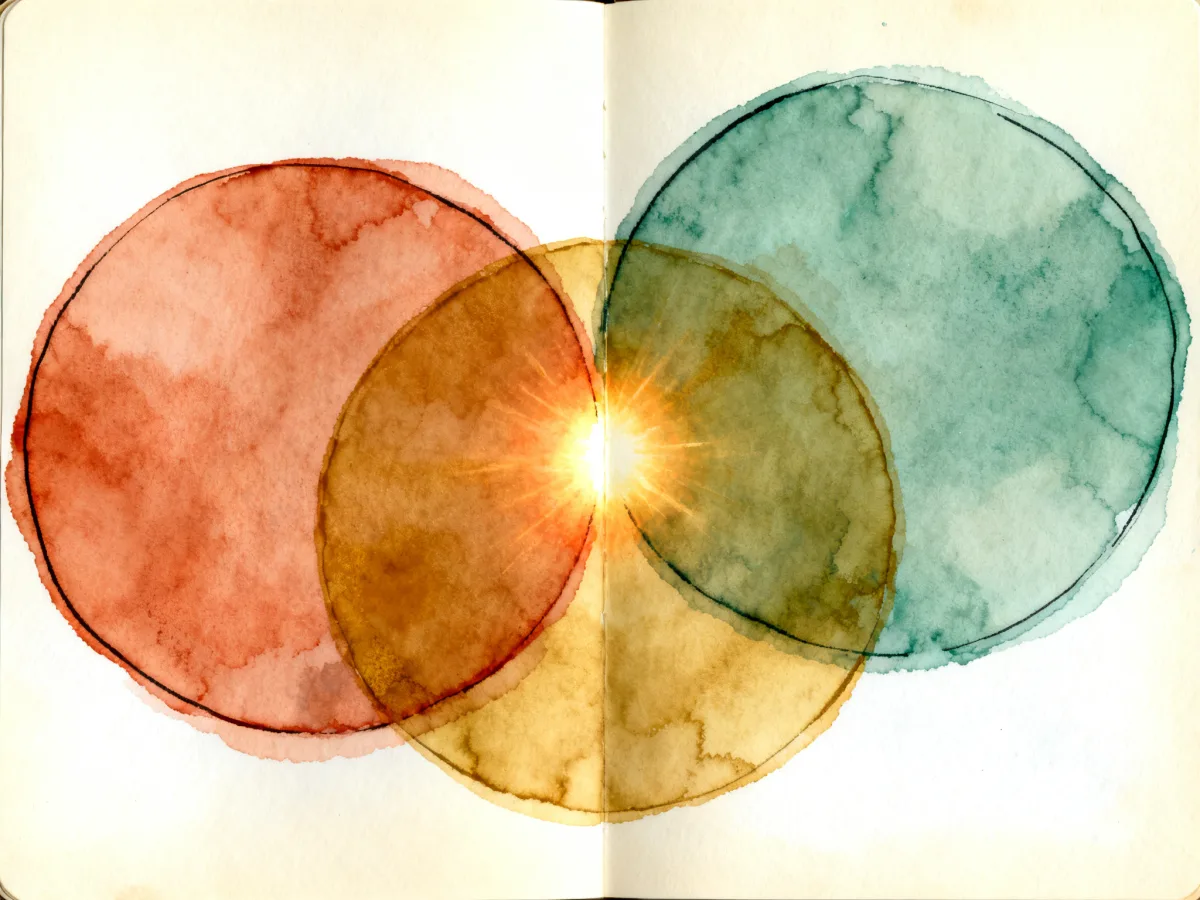
The Future Is Here
I didn't go searching for this spot. I've just always felt a deep pull towards this place, the overlap of business, marketing and AI. It's the spot that makes the most sense to me. It's also the spot where I feel most useful in the world. I've spent years here now. It has influenced most of what I believe. This is what I see.
Everything is changing.
The assumptions underneath how a business gets built and run are being rewritten all at once. It will take years to finish playing out, and nobody can see the end of it yet. But you cannot sit it out and try to catch up later, because the gap compounds while you wait.
It's moving faster than you think.
Whatever rate of improvement you've priced in, nudge it up. Then nudge it again. The models don't have to be perfect to break the old maths of who does what for money. They only have to get better than average, and they passed average a while ago.
Context is the lever.
The quality of what you get out has almost nothing to do with the model and almost everything to do with the context you feed it. The prompt matters less than you might think. The context matters more. That is the whole reason I built the 8020brain, to organise what the model knows so it does great work without me hovering. There's a trap though. The scaffolding you build to prop up a weaker model becomes the thing that holds a stronger one back. So you need to prune regularly. You don't reset, you prune.
Judgment and taste are the scarce thing now.
When the doing gets cheap, the deciding gets expensive. What to build, in what order, what to ignore, what's good enough, what should never have been started at all. For verifiable work the need to check every line of AI output fades. For anything going out into the world with your name on it, you keep a hand on the gate. You still need to be accountable.
You find the path by playing.
You can't plan your way to the frontier, because the map doesn't exist yet. You just start walking. You make something, you play with it, and the next move only shows itself once you start. The adjacent possible opens one door at a time, and you only reach the second door by walking through the first. This is where the craft lives, and it's why I keep going on about iterative craft. AI should shorten your journey to something exceptional, not teleport you to something mediocre. The iteration is the craft. Skip it and all you've done is ship average shit faster.
The old rituals are just drag.
Most of how we work was invented for a world where doing the thing was slow, costly, and human. Think of the retainer, the two-week turnaround, the meeting booked to arrange another meeting. A lot of that is now friction wearing the costume of process. Treating your agent like a junior employee is a fine way in, a useful picture to hold in your head. Those are the training wheels though, not the finish line. An agent working like an employee is an under-used agent.
The floor is moving.
Software that exists to do X loses its value the moment an agent just does X. So does the subscription, the freelancer, the agency whose whole pitch was "you couldn't build this yourself." That value doesn't vanish, it moves. It moves toward the things an agent can't hand you: trust, the first party data, your distribution, your reputation, your judgment. An agency that only makes money managing ads has two roads from here. Be in the top one percent in the world and be known for it, or earn your keep by adding real value somewhere machines can't.
Agility wins now.
This was never really about size. A big company can be quick and a small one can be a sloth. It's about how fast you can change your mind and move. The giant mostly can't turn. You can. The thing every large organisation is now scrambling to assemble, a tiny group with good judgment and a swarm of agents and nothing in the way, might be something you already are. The technology is the easy part. The hard part is your people, because most of them are nervous, and you cannot committee your way through nervous. You take them with you, and that starts with leadership saying clearly (out loud) why this matters, why now, and what's in it for them.
Resist the slop. Stay extraHuman™.
All this speed has a failure mode. You've seen the slop. Just because a machine can produce something doesn't mean anyone should have to read it. My rule of thumb is simple: if it took you less time to make than it takes me to read, it's probably slop. The craft is in the brevity, the clarity, the choosing of what not to send. So stay close to the work that made you good in the first place, and don't let an agent slide in between you and your craft. Use the tools to get back more of what makes you you: the work that needs your judgment, the room to think properly, the energy left at the end of the day for the people and the hobbies you actually care about. The goal was never to become less human. It was to become a little extraHuman™.
Therefore.
Go to the frontier. Build for a world where intelligence is cheap, always on, and everywhere. Stop protecting old habits just because they feel comfortable. Don't wait for confidence, or capability, before you move. Just move. Please.
Leadership needs to describe the summit. The scouts run ahead, and experiment. Go with them. Then you bring the rest of the team along once the scouts pave the path.
And if you've read this far and something is pulling you forward, the diagram above was never really about me. You're already standing on the spot. If you're a scout, it's time to go and find out what's over the ridge.