You don't increase prices because you're worried about annoying clients
I get it. I've been there. And... let me share a tiny bit of maths.
If you have a 20% net margin (industry average) and you put prices up 10%, you could lose a third of your clients & still make the same profit.
And I bet you have some clients you haven't increased prices for in 3+ years. Inflation is about 4% now (but you knew that).
Worse still, you might feel you need to discount to win the next new client. It's similar maths in the opposite direction.
I was lucky to be shown the first of these three tables early in my business & it completely changed how I thought about fees. The other two I drew up later, because the discount table only tells half the story. Maybe they'll help you.
1. The real cost of a discount
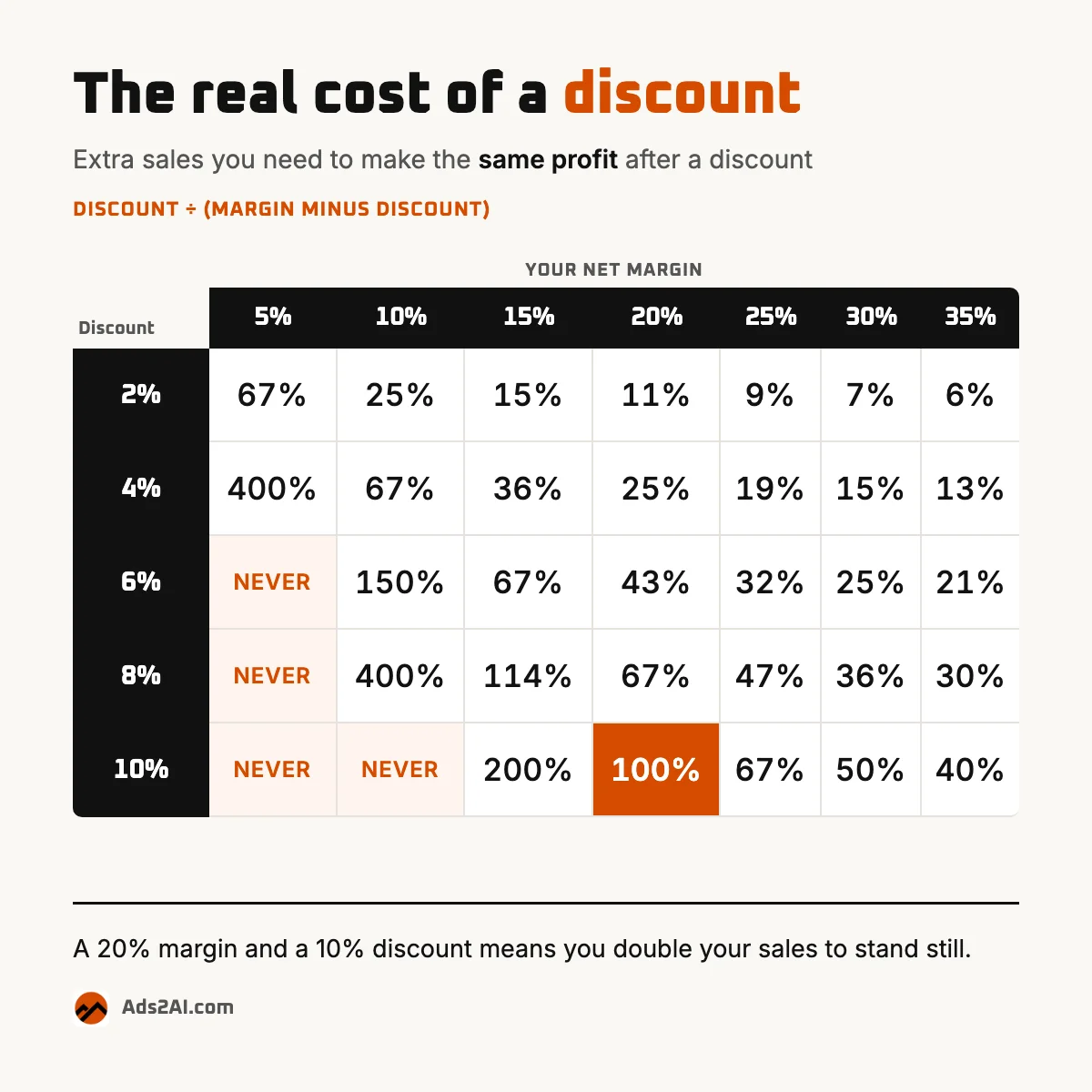
20% margin, a client asks for 10% off & you say yes, because 10% doesn't sound like much.
Your margin on that client drops to 10%. To earn back the profit you gave away, you need twice as many clients at the new price. The table shows how much extra you need to sell for every combination of margin and discount.
| Discount ↓ · Margin → | 5% | 10% | 15% | 20% | 25% | 30% | 35% |
|---|---|---|---|---|---|---|---|
| 2% | 67% | 25% | 15% | 11% | 9% | 7% | 6% |
| 4% | 400% | 67% | 36% | 25% | 19% | 15% | 13% |
| 6% | never | 150% | 67% | 43% | 32% | 25% | 21% |
| 8% | never | 400% | 114% | 67% | 47% | 36% | 30% |
| 10% | never | never | 200% | 100% | 67% | 50% | 40% |
Running at a 10% margin? A 10% discount means you're working for free, and the "never" cells mean no amount of extra volume gets the profit back.
2. The real benefit of a price rise
Same 20% margin. Instead of 10% off, you ask for 10% more.
If nobody leaves, your profit goes up 50%. Same clients, same work, half as much again in the bank.
| Price rise ↓ · Margin → | 5% | 10% | 15% | 20% | 25% | 30% | 35% |
|---|---|---|---|---|---|---|---|
| 2% | 40% | 20% | 13% | 10% | 8% | 7% | 6% |
| 4% | 80% | 40% | 27% | 20% | 16% | 13% | 11% |
| 6% | 120% | 60% | 40% | 30% | 24% | 20% | 17% |
| 8% | 160% | 80% | 53% | 40% | 32% | 27% | 23% |
| 10% | 200% | 100% | 67% | 50% | 40% | 33% | 29% |
At a 10% margin, a 10% rise doubles your profit. The thinner your margin, the bigger the benefit of that small increase.
3. How many clients could you afford to lose?
This is the table that answers the worry. After a price rise, this many clients could leave and you'd still make the same profit as before.
| Price rise ↓ · Margin → | 5% | 10% | 15% | 20% | 25% | 30% | 35% |
|---|---|---|---|---|---|---|---|
| 2% | 29% | 17% | 12% | 9% | 7% | 6% | 5% |
| 4% | 44% | 29% | 21% | 17% | 14% | 12% | 10% |
| 6% | 55% | 38% | 29% | 23% | 19% | 17% | 15% |
| 8% | 62% | 44% | 35% | 29% | 24% | 21% | 19% |
| 10% | 67% | 50% | 40% | 33% | 29% | 25% | 22% |
At a 20% margin and a 10% rise, a third of your clients could leave & you'd make the same profit, with a third fewer reports, emails, calls & late-night Slack messages. At a 10% margin, half could leave & you'd be in the same place profit-wise.
If a third of your clients would leave over 10%, I'd have questions about those clients.
The maths, if you want to check the numbers yourself
- Extra sales needed after a discount: discount ÷ (margin minus discount)
- Profit gain from a price rise, if nobody leaves: rise ÷ margin
- Clients you could afford to lose: rise ÷ (margin plus rise)
All three assume your cost per client stays about the same as volume changes, which for an agency is roughly true. More clients means more hands.
When a discount is the right call
There are times to discount on purpose: a new market, a logo you want as a case study, a client you're protecting from a competitor for a quarter, a cheap product that leads to a profitable one. Those are decisions you make strategically, before anyone asked.
A discount because someone asked for one is almost always worth saying no to.
When's your next pricing conversation?